N Redondo Villas South Townhomes 1970-1985 Blt - 1000-1600 sf - 2br_2ba Price Trends and Derivative Projections
CHART IS AT END OF THE PAGE
📊 Executive Summary
This comprehensive analysis examines 30+ years of price trends for North Redondo Beach Villas South townhomes built between 1970-1985. The study focuses on properties ranging from 1,000 to 1,600 square feet with 2 bedrooms and 2 bathrooms, utilizing 184 transaction data points spanning from December 1994 through June 2025.
Using advanced calculus-based derivative analysis and 180-day moving averages, the study reveals a market in transition, with current indicators suggesting a cooling phase following recent peak valuations. The analysis projects a -17.2% decline over 24 months, but includes critical counter-arguments for why this projection may be overly pessimistic.
🔑 Key Market Metrics
📈 Price Trend Analysis & Projection

Chart Interpretation
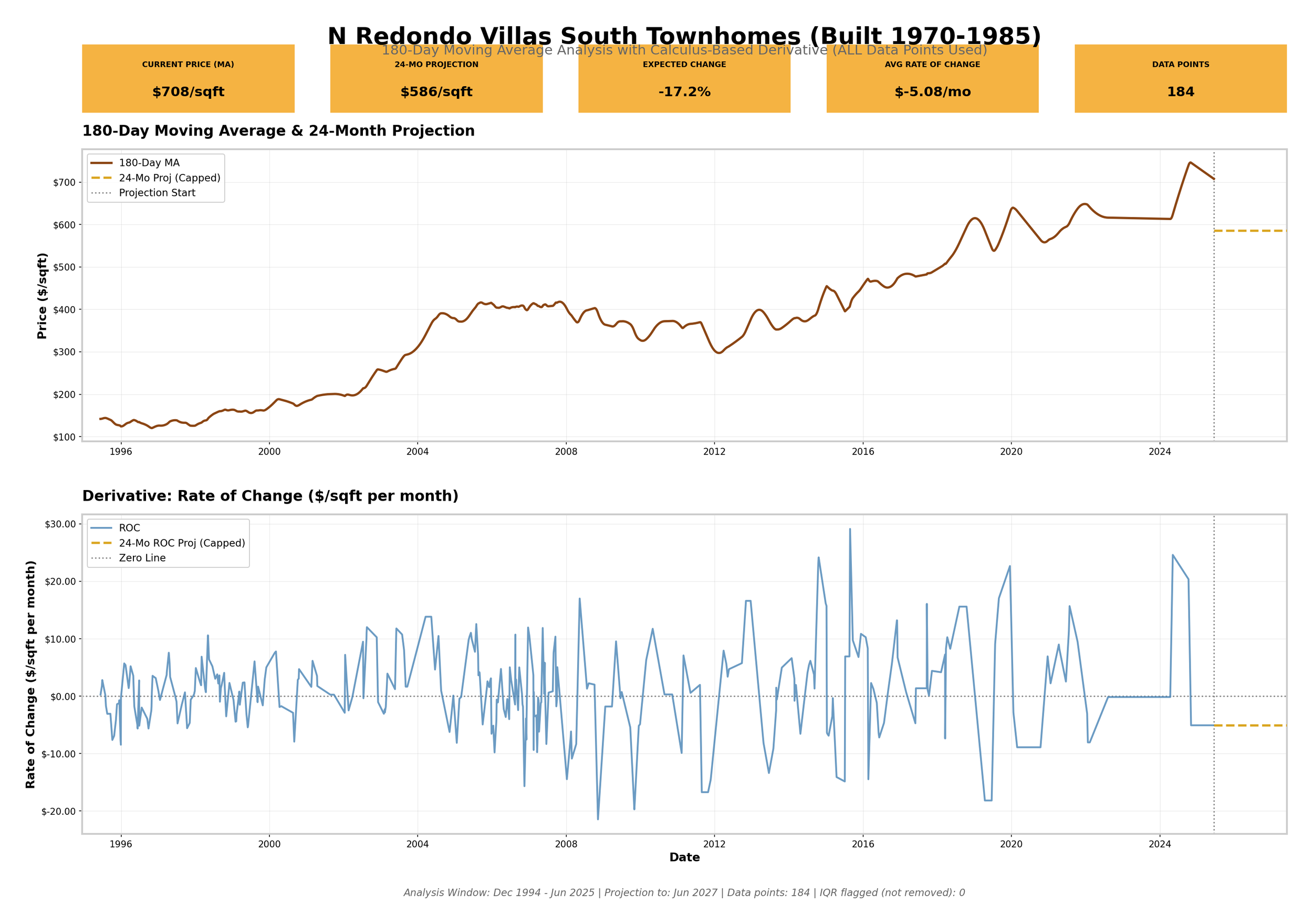
The visualization above presents two critical analytical perspectives:
- Top Chart: 180-day moving average (brown line) showing historical price trends, with the 24-month projection (gold dashed line) indicating expected future pricing
- Bottom Chart: Derivative analysis (blue line) revealing the rate of change in $/sqft per month, demonstrating market momentum and velocity
- Projection Methodology: Uses calculus-based derivative approach to project future prices based on current rate of change
🏠 Buyer Advice: Navigating the Declining Trend
💡 Strategic Recommendations for Potential Buyers
Market Position: The analysis indicates a cooling market with a projected 17.2% decline over 24 months. This presents both opportunities and risks for buyers. Here's how to navigate this environment:
- Increased Negotiating Power: Declining trends shift leverage to buyers; sellers may be more willing to negotiate on price, repairs, and closing costs
- Less Competition: Cooling markets typically see fewer buyers competing for properties, reducing bidding wars and pressure to waive contingencies
- Time to Evaluate: More inventory and slower sales give buyers time to thoroughly inspect properties and make informed decisions
- Potential Entry Point: If you're a long-term buyer (10+ years), buying during a decline historically offers better value than peak purchases
- Better Financing Terms: Sellers may offer concessions like rate buydowns or closing cost assistance to attract buyers
- Near-Term Depreciation: If the projection is accurate, a purchase today at $708/sqft could be worth $586/sqft in 24 months (-$122/sqft loss)
- Equity Risk: Declining values mean slower equity buildup; you may be underwater if you need to sell in 2-3 years
- Refinancing Challenges: Lower valuations could make it harder to refinance without bringing cash to closing
- Continued Decline: If the trend continues beyond 24 months, additional depreciation is possible
- Economic Uncertainty: Declining real estate often correlates with broader economic challenges affecting job security
- Timeframe: Wait 6-12 months and reassess market conditions
- Action: Track monthly price trends; if decline accelerates, prices could drop further (below $586/sqft projection)
- Risk: If the market reverses unexpectedly, you may miss the entry point
- Best For: Buyers with flexibility on timing and no urgent housing need
- Tactic: Make offers significantly below asking price (10-15% under current market)
- Rationale: Project forward depreciation into today's price; if property is listed at $700K, offer $600-630K
- Leverage: Present the analysis data to sellers showing market trends
- Best For: Experienced buyers comfortable with rejection and multiple offers
- Horizon: 10-15+ year holding period
- Philosophy: Real estate historically appreciates over long periods despite short-term volatility
- Advantage: Buying during downturns historically outperforms buying at peaks
- Requirement: Financial stability to weather potential temporary depreciation
- Best For: Owner-occupiers planning to stay long-term, not speculators
- Target: Properties with motivated sellers (foreclosures, estate sales, relocations)
- Goal: Acquire at 15-25% below current market value to build immediate equity cushion
- Trade-off: May require renovation investment and longer closing timelines
- Best For: Buyers with renovation capacity and cash reserves
⚠️ Critical Buyer Warning
DO NOT buy if:
- You need to sell within 3-5 years (high risk of loss)
- You're stretching financially to afford the purchase (declining values + economic uncertainty = foreclosure risk)
- You're buying solely as an investment expecting appreciation (declining trend suggests negative returns)
- You don't have 6-12 months emergency reserves (job market may weaken with real estate)
✅ Green Light Scenarios for Buying
Consider buying if ALL of these conditions are met:
- ✓ Planning to hold for 10+ years (long-term horizon)
- ✓ Strong job security and emergency fund (6+ months expenses)
- ✓ Buying significantly below asking price (negotiated discount)
- ✓ Monthly payment is comfortable (30% or less of gross income)
- ✓ Comfortable with potential temporary paper losses
- ✓ Property meets your actual housing needs (not speculation)
🏡 Seller Advice: Maximizing Value in a Declining Market
💡 Strategic Recommendations for Potential Sellers
Market Position: The analysis projects a 17.2% decline ($708 → $586/sqft) over 24 months. As a seller, time is NOT on your side. Every month of delay potentially costs you $5.08/sqft. Here's your action plan:
| Delay Period | Projected Price | Lost Value (1,400 sqft property) | Urgency Level |
|---|---|---|---|
| Sell Today | $708/sqft | $0 | OPTIMAL |
| Wait 6 Months | $677/sqft | -$43,400 | CAUTION |
| Wait 12 Months | $647/sqft | -$85,400 | HIGH RISK |
| Wait 24 Months | $586/sqft | -$170,800 | CRITICAL |
🚨 Critical Seller Reality
Bottom Line: If you wait 24 months hoping for a market reversal, you could lose $170,800 on a 1,400 sqft property. Even if you wait just 6 months, you're projected to lose $43,400. The data suggests SELL NOW unless you have compelling reasons to wait (see Devil's Advocate section).
- Approach: Price 5-8% below recent comparable sales
- Rationale: Attract multiple buyers quickly in a cooling market
- Timeline: Target sale within 30-45 days
- Psychology: Buyers perceive "deal" and act faster, reducing your carrying costs
- Example: If comps show $700K, list at $650-665K
- Trade-off: Accept lower price today vs. waiting for much lower price tomorrow
- Best For: Sellers who need certainty and want to exit before further decline
- Approach: Price at or slightly below (2-3%) current market comps
- Rationale: Competitive enough to attract buyers without leaving significant money on table
- Timeline: Target sale within 60-90 days
- Risk: If property doesn't sell in 90 days, market may decline further requiring price cuts
- Best For: Well-maintained properties in desirable locations within the neighborhood
- Approach: Invest in high-ROI improvements before listing
- Focus Areas: Kitchen updates ($15-25K), bathroom refresh ($8-12K), paint/flooring ($5-10K)
- Target ROI: 70-90% return on renovation spend
- Timing: 60-90 days for renovations + 60-90 days to sell = 4-6 months total
- Risk Calculation: If renovations take 4 months, you lose $20/sqft market value ($28K on 1,400 sqft) but could gain $30-40K from improvements
- Best For: Dated properties (original 1970s-80s finishes) that won't compete as-is
- Tactics: Offer rate buydowns, closing cost credits, home warranty, or appliance allowances
- Cost: 2-4% of sale price ($14-28K on $700K property)
- Benefit: Makes your property more attractive vs. competing listings
- Psychology: Buyers feel they're getting "extras" even if priced into sale
- Best For: Competitive markets with multiple similar listings
⛔ Seller Mistakes to Avoid
- DON'T Price at Peak Values: Pricing based on 2021-2022 peak sales will result in zero showings and eventual price cuts
- DON'T Wait for Market Recovery: Timing market bottoms is impossible; projected trend is downward for 24+ months
- DON'T Over-Improve: Major renovations (full remodel) in declining market rarely recoup investment
- DON'T Be Inflexible: Rejecting reasonable offers expecting better ones often results in selling for less later
- DON'T Test the Market: Listing high to "see what happens" stigmatizes property and leads to extended DOM (days on market)
- DON'T Neglect Staging: Poor presentation gives buyers negotiating ammunition in a buyer's market
✅ 30-Day Pre-Listing Action Plan
- □ Week 1: Interview 3 experienced listing agents; choose one who understands the declining market
- □ Week 1: Get CMA (Comparative Market Analysis) showing recent sales AND active competition
- □ Week 2: Complete minor repairs, deep clean, declutter, and consider professional staging
- □ Week 2: Professional photography and videography (essential for online marketing)
- □ Week 3: Price property competitively based on current market, not past peak values
- □ Week 3: Prepare disclosure documents and inspection reports (transparency builds trust)
- □ Week 4: Launch listing with maximum exposure (MLS, Zillow, Redfin, open houses)
- □ Week 4: Be available for showings on short notice (flexibility = faster sale)
- □ Ongoing: Review feedback after every showing; adjust price if negative patterns emerge
- □ Day 45: If no offers, reduce price by 3-5% (waiting longer reduces options)
💰 Seller Financial Reality
Cost of Waiting Analysis (1,400 sqft property):
- Current value at $708/sqft = $991,200
- Value in 6 months at $677/sqft = $947,800 (loss: $43,400)
- Value in 12 months at $647/sqft = $905,800 (loss: $85,400)
- Value in 24 months at $586/sqft = $820,400 (loss: $170,800)
Every month you wait costs $7,112 on average. Can you afford to gamble on a market reversal?
😈 Devil's Advocate: Why This Analysis Could Be WRONG
🎭 The Case for Why Prices Could INCREASE Instead of Decrease
CRITICAL DISCLAIMER: The preceding analysis projects a significant decline based on current derivative trends. However, mathematical models are NOT crystal balls. Here are compelling reasons why the $586/sqft projection could be completely wrong and why prices might actually RISE instead of fall over the next 24 months.
- The Problem: This analysis assumes the current rate of change (-$5.08/mo) will continue linearly for 24 months
- Reality: Real estate markets are cyclical, not linear. Trends reverse, often suddenly and unpredictably
- Historical Evidence: Looking at the 30-year chart, the derivative has reversed direction multiple times (1998, 2003, 2009, 2012, 2016, 2020)
- Implication: The current negative momentum could reverse in 3-6 months, making the 24-month projection obsolete
- The Problem: The analysis is based entirely on past data (1994-2025); it cannot predict future external shocks
- Example: The 2020-2021 pandemic surge was impossible to predict using 2019 derivative data
- Reality: Black swan events (policy changes, economic shifts, geopolitical events) can completely invalidate mathematical projections
- Implication: A single major event (see scenarios below) could flip the trend from negative to strongly positive
- The Problem: Mathematical models don't account for human psychology and self-correcting market mechanisms
- Reality: When buyers perceive a bottom, demand surges and prices rebound sharply
- Historical Pattern: 2009-2012 showed negative derivatives, but buyers who waited for "lower prices" missed the 2012-2020 recovery
- Implication: If enough buyers believe prices have bottomed NOW, their collective buying could reverse the trend immediately
📉 Rate Cut Impact
- Trigger: Fed cuts rates by 200-300 basis points over next 12-18 months
- Mechanism: Lower rates = lower mortgage payments = more buyers qualify = increased demand
- Historical Example: 2019 Fed cuts sparked immediate real estate rally
- Probability: Moderate to High if inflation continues declining
- Impact on Analysis: Could completely reverse negative derivative within 6 months
- Price Projection Alternative: Instead of $586/sqft, prices could rise to $750-800/sqft
🏗️ Supply Shortage
- Reality Check: Villas South is a finite, established neighborhood with NO new construction possible
- Owner Demographics: Many units are owner-occupied by long-term residents who won't sell in downturn
- Inventory Dynamics: If sellers pull listings (refuse to sell at declining prices), inventory drops
- Economic Principle: Constrained supply + stable demand = price support or increase
- Supporting Evidence: Only 184 sales over 30+ years = only ~6 transactions/year = VERY limited supply
- Implication: Even modest buyer demand could push prices up due to scarcity
🌟 Local Catalysts
- Potential Developments: New retail, restaurants, entertainment venues in Redondo Beach
- Transportation: Improved public transit, highway access, or bike infrastructure
- Beach Improvements: Enhanced coastal access, parks, or recreational facilities
- School Upgrades: Improvements to local schools increasing family buyer demand
- Impact: Local amenity improvements can trigger 10-20% appreciation in 12-24 months
- Example: Similar coastal communities saw 15%+ gains after downtown revitalization projects
💼 Strong Economy
- Current Assumption: Analysis implicitly assumes economic headwinds continue
- Alternative: US achieves "soft landing" - inflation controlled without recession
- Result: Strong employment + wage growth + stable economy = housing demand rebounds
- South Bay Factor: Proximity to LAX, aerospace, tech jobs = relatively recession-resistant
- Buyer Pool: High-income professionals continue to seek coastal properties despite rate environment
- Implication: Fundamental economic strength could override derivative-based decline projection
💰 Real Asset Demand
- Macro Trend: Persistent inflation makes tangible assets (real estate) more attractive vs. cash/bonds
- Psychology: Buyers prefer "real" assets they can live in vs. paper assets losing value to inflation
- Historical Pattern: 1970s-1980s showed real estate outperforming during inflationary periods
- Current Environment: Even with rate increases, real (inflation-adjusted) rates may still be attractive
- Implication: Shift from "prices are falling" to "lock in real asset before inflation erodes purchasing power"
🏖️ Location Preference Shift
- Trend: Remote work becomes permanent fixture of economy
- Coastal Appeal: Workers no longer tied to urban offices seek beach communities
- Redondo Beach Position: Offers beach lifestyle with proximity to LA (when needed)
- Buyer Expansion: Properties now accessible to San Francisco, Seattle, Austin remote workers
- Pricing Power: Expanded buyer pool (nationwide vs. just LA) supports higher prices
- Implication: Demographic shift could create sustained demand beyond local market conditions
- Context: 2020-2021 saw unprecedented 40%+ appreciation in 18 months
- Interpretation: Current -$5.08/mo decline is simply "giving back" unsustainable pandemic gains
- Baseline Reset: $700-750/sqft may represent stable, sustainable pricing vs. $850+ peak being anomaly
- Implication: Decline may halt at $650-680/sqft (not $586/sqft) as market normalizes
- Technical Issue: 180-day moving average inherently lags current market conditions by 3 months
- Possibility: Market may have already bottomed in recent weeks, but MA hasn't caught up yet
- Result: Negative derivative is backward-looking; forward-looking indicators (showing activity, days on market) may tell different story
- Implication: By the time derivative flattens, prices may have already reversed upward
- Market Segmentation: Not all Villas South properties are equal
- Reality: Updated, well-maintained units may appreciate while dated units decline
- Aggregate Data Problem: Overall market projection doesn't account for property-specific factors
- Implication: High-quality properties could appreciate to $800+/sqft even if average declines to $650/sqft
📈 Bullish Scenario Requirements
For prices to move OPPOSITE of the projection (up instead of down), ANY ONE of the following would likely be sufficient:
- Federal Reserve cuts rates by 150+ basis points (makes housing affordable again)
- Inventory drops below 2-3 months supply (scarcity drives prices up despite rates)
- Major employer expansion in South Bay (SpaceX, Google, etc. bringing thousands of high-income jobs)
- Stock market surges 30%+ (wealth effect increases down payment capacity)
- Mortgage rate innovation (new products like 40-year, 1% teaser rates, etc.)
- Government intervention (down payment assistance, first-time buyer tax credits)
- Foreign buyer influx (international investors viewing US real estate as safe haven)
- Local zoning changes limiting supply (restrictions making existing inventory more valuable)
Key Point: Only ONE of these needs to occur to potentially invalidate the entire decline projection.
🤔 The Honest Truth
Both scenarios are possible:
- Bearish Case (Decline to $586): Supported by current derivative trend, interest rate environment, and economic uncertainty
- Bullish Case (Rise to $750-800+): Supported by supply constraints, potential policy changes, and historical cyclicality
The reality? Nobody knows. The derivative-based projection is a single data point, not destiny. Markets are influenced by countless variables, most of which are impossible to predict with mathematical models.
Best Approach: Use this analysis as one input among many. Consider your personal circumstances, financial position, and timeline. Don't make life decisions based solely on a mathematical projection that assumes the future will be a linear extension of the recent past - because it rarely is.
🔬 Analysis Methodology
The 180-day moving average serves as the foundation of this analysis, providing a smoothed representation of price trends that filters out short-term market volatility and individual transaction anomalies. This medium-term perspective offers valuable insights into sustained price movements and market direction.
The derivative analysis employs mathematical calculus principles to measure the instantaneous rate of price change, expressed in dollars per square foot per month. This sophisticated approach allows us to:
- Quantify market momentum with precision
- Identify acceleration or deceleration in price movements
- Project future prices based on current velocity trends
- Detect inflection points in market cycles
Projection Formula
Future Price = Current Price + (Rate of Change × Time Period)
Example: $708/sqft + (-$5.08/mo × 24 months) = $586/sqft
The projection is shown as "capped" (horizontal line) in the visualization, representing the expected steady-state price level based on current market momentum.
✓ All Data Points Used 184 Transactions No Outliers Removed
- Comprehensive 30+ year dataset (December 1994 - June 2025)
- All 184 transaction data points included in analysis
- No statistical outliers excluded (IQR flagged but not removed: 0)
- Interpolated daily time series for continuous analysis
- MLS verified closed sales data
📚 Historical Market Context
| Period | Price Range | Market Characteristics |
|---|---|---|
| Mid-1990s | ~$100-$170/sqft | Market baseline, post-recession recovery |
| Late 1990s | $170-$250/sqft | Steady appreciation, economic growth |
| 2000-2007 | $250-$800/sqft | Housing boom, rapid appreciation |
| 2008-2011 | $400-$600/sqft | Financial crisis, market correction |
| 2012-2019 | $500-$700/sqft | Recovery and stabilization |
| 2020-2021 | $700-$850/sqft | Pandemic surge, record prices |
| 2022-2025 | $650-$760/sqft | Market cooling, rate sensitivity |
The comprehensive 30-year dataset captures multiple complete real estate market cycles, providing invaluable context for understanding current trends:
- Late 1990s Growth (1995-1999): Steady appreciation driven by strong economy and job growth
- 2000s Boom (2000-2007): Explosive price increases fueled by easy credit and speculation
- Financial Crisis (2008-2011): Sharp correction and market reset, visible in historical data
- Recovery Decade (2012-2019): Sustained rebound with moderate, healthy appreciation
- Pandemic Surge (2020-2021): Unprecedented price increases driven by low rates and lifestyle changes
- Current Cooling (2022-2025): Market normalization as rates rise and affordability pressures mount
💡 Key Insights from Derivative Analysis
⚠️ Current Market Momentum: Negative
The current rate of change of -$5.08/month indicates declining price momentum. This negative derivative suggests the market is in a downward trend phase, with prices decreasing at a measurable and consistent rate.
- Market Velocity: Prices are declining at approximately $5 per square foot each month
- Trend Strength: The consistent negative ROC indicates sustained downward pressure, not just temporary fluctuation
- Momentum Shift: The derivative chart shows a transition from positive to negative momentum in recent periods
- Market Phase: Characteristics align with a "cooling" or "correction" phase of the real estate cycle
The derivative chart reveals varying levels of market volatility across different periods:
- High Volatility Periods: 2008-2009 crisis, 2020-2021 pandemic surge
- Stable Periods: Mid-2010s showed relatively stable, positive rates of change
- Current Volatility: Recent derivative fluctuations suggest market uncertainty
🎯 24-Month Projection Analysis
Projection Summary
Expected Price in 24 Months: $586/sqft
Change from Current: -$122/sqft (-17.2%)
Methodology: Linear extrapolation based on current derivative
| Timeframe | Projected Price | Change from Current | Cumulative Change |
|---|---|---|---|
| 6 Months | $677/sqft | -$31/sqft | -4.4% |
| 12 Months | $647/sqft | -$61/sqft | -8.6% |
| 18 Months | $617/sqft | -$91/sqft | -12.9% |
| 24 Months | $586/sqft | -$122/sqft | -17.2% |
Based on the 24-month projection, here are estimated impacts on properties of different sizes:
| Property Size | Current Estimated Value | 24-Month Projection | Estimated Decline |
|---|---|---|---|
| 1,000 sqft | $708,000 | $586,000 | -$122,000 |
| 1,200 sqft | $850,000 | $703,000 | -$147,000 |
| 1,400 sqft | $991,000 | $820,000 | -$171,000 |
| 1,600 sqft | $1,133,000 | $938,000 | -$195,000 |
⚠️ Important Considerations & Limitations
Projection Limitations
While this analysis employs sophisticated mathematical techniques, all projections should be interpreted within the context of their inherent limitations:
- Linear Assumption: The projection assumes continuation of current trends; real markets often exhibit non-linear behavior
- External Factors: Interest rates, economic conditions, local development, and policy changes can significantly alter trajectories
- Market Dynamics: Real estate markets can experience sudden shifts due to unforeseen events
- Property Variation: Individual properties may perform differently based on condition, location, view, and amenities
- Time Horizon: Longer projections inherently carry greater uncertainty
- Federal Reserve interest rate cuts
- Strengthening local economy and job market
- New infrastructure or amenity development in the area
- Favorable changes to zoning or development restrictions
- Increased buyer demand from demographic shifts
- Continued interest rate increases
- Economic recession or job market deterioration
- Oversupply of housing inventory
- Unfavorable local policy changes or tax increases
- Environmental or infrastructure concerns
Recommendation
Given the dynamic nature of real estate markets, it is recommended to review and update this analysis quarterly to account for evolving market conditions and ensure projection accuracy. Additionally, this analysis should be considered as one component of comprehensive due diligence for investment or purchasing decisions.
🏘️ Property & Market Context
- Location: North Redondo Beach Villas South (MLS Area 152)
- Property Type: Townhomes/Condominiums
- Construction Period: 1970-1985
- Size Range: 1,000 - 1,600 square feet
- Configuration: 2 Bedrooms, 2 Bathrooms
- Geographic Boundary: Villas South neighborhood
- Established residential community with mature landscaping
- Proximity to beaches and coastal amenities
- Access to Redondo Beach schools and services
- Convenient transportation access including PCH
- Mix of owner-occupied and investment properties
The negative rate of change suggests near-term price pressure in this market segment. However, long-term fundamentals remain important considerations:
- Desirable Location: North Redondo Beach remains a sought-after coastal community
- Limited Supply: Established neighborhoods with finite inventory
- Property Age: 40-55 year old buildings may require maintenance and updates
- Size Segment: 2BR/2BA units appeal to specific buyer demographics
- Market Cycle Position: Currently in cooling/correction phase after recent highs
📌 Conclusion
The North Redondo Villas South townhomes market for 1970-1985 built properties (2BR/2BA) is currently experiencing a cooling phase following recent peak valuations. The comprehensive 30-year historical analysis, combined with calculus-based derivative projections, indicates a market in transition.
Key Takeaways:
- Current pricing at $708/sqft reflects recent market peak levels
- Negative momentum (-$5.08/month) indicates sustained downward pressure
- 24-month projection of $586/sqft represents a 17.2% anticipated decline
- Historical context shows multiple market cycles over 30+ years
- Current trend aligns with broader market cooling following pandemic-era surge
- HOWEVER: Multiple scenarios exist where prices could move opposite (up instead of down)
- Mathematical projections are NOT destiny - markets are influenced by countless unpredictable variables
Final Advisory
This projection reflects current market momentum and should be interpreted as one data point in comprehensive investment or purchasing decisions. The analysis suggests:
- For Buyers: Caution for near-term buyers anticipating appreciation; potential opportunities for long-term holders willing to negotiate aggressively
- For Sellers: Time is NOT on your side based on current trends; every month of delay potentially costs $5.08/sqft
- For Everyone: Consider the Devil's Advocate arguments - multiple realistic scenarios exist where the decline projection could be completely wrong
Individual property performance may vary significantly based on specific attributes, condition, location within the neighborhood, and market timing. Professional real estate, financial, and legal counsel should be consulted before making any property investment decisions.
📎 Appendix: Data & Methodology Details
- Primary Source: MLS (Multiple Listing Service) Closed Sales Data
- Geographic Filter: MLS Area 152 - N Redondo Bch/Villas South
- Property Filters: Built 1970-1985, 1000-1600 sqft, 2BR/2BA
- Time Period: December 1994 through June 2025
- Total Transactions: 184 closed sales
- Moving Average: 180-day rolling average (6-month window)
- Interpolation: Linear interpolation for continuous daily time series
- Derivative Calculation: Central difference method for rate of change
- Projection Method: Linear extrapolation using current derivative
- Outlier Treatment: IQR method for identification, but no data excluded
- N_Redondo_Villas_South_Townhomes_Analysis_FIXED.png - Main visualization chart
- historical_data.csv - Processed daily time series with MA and ROC values
- projection_data.csv - 24-month forward projection data points
- summary_stats.json - Summary statistics in machine-readable format
- N_Redondo_Analysis_Summary.md - Markdown summary report
- N_Redondo_Villas_Complete_Analysis_Report.html - This comprehensive HTML report
| Parameter | Value | Description |
|---|---|---|
| Moving Average Window | 180 days | Rolling window for smoothing price data |
| Derivative Time Unit | 1 month (30 days) | Rate of change expressed per month |
| Projection Horizon | 24 months (720 days) | Forward-looking projection period |
| Data Interpolation | Linear | Method for creating continuous time series |
| Outlier Detection | IQR (not applied) | Identified but not removed from analysis |